Thursday, February 01, 2007

hiatus (and how smelling food makes flies die earlier)

After some thought, I've decided to put this blog on a hiatus of indefinite extent. It has been an enjoyable project, and I've learned a lot in the last year and a half, and accomplished many of the goals I set out for myself. Much of the reason I've decided not to continue this blog, at least in its current format, is that many of my goals are now being done much better by other people! Here are some blogs that I read and enjoy...

Some favorite food blogs:
Accidental Hedonist
Cooking for Engineers
Megnut
Slashfood

Some favorite science blogs:
Cognitive Daily
The Loom
Uncertain Principles
Language Log

Some favorite New York City blogs:
Curbed
StreetsBlog

(and, as always, my blogroll is publically available here.)

I'll still be cooking and taking photos (of food and other things). My photos are hosted at Zooomr, and feel free subscribe to my photo feed with the usual RSS tools. I'll try to link those photos to recipes, or otherwise to note the origin of the dishes in a comment.

I may restart this blog at some point in the future, perhaps with a different focus. But for now, thanks for reading!

And as a final science-of-food note, National Geographic has a story today about an article to be published tomorrow in Science.

Many animals—from monkeys to mice to microscopic worms—live longer when they eat less than their fill. ... The effect may occur because animals are genetically programmed with strategies for dealing with food shortages. During famines, for instance, they could put more their energy into repairing their bodies and living longer. But when a cornucopia of food abounds, the animals put their energy into making babies. At normal food levels, for example, flies live about 45 days. When they can eat as much as they want, the flies only last about 35 days. But when they're on the optimal diet, they live about 55 days—about 60 percent longer. The smell of food erased about a quarter of the gain they got from dieting, though.

(Emphasis mine...) So those harsh caloric-restriction diets are less effective if you're surrounded by the tasty smells of bacon, and baking bread, and sauteeing onions... How about that.

Labels: , , ,

Tuesday, January 09, 2007

chocolate truffles

As promised recently, I made truffles. (The suffering I go through when having to use up a pound of Callebaut baking chocolate!) They're not technically difficult, but there do seem to be some tricks, not all of which I've figured out yet. Despite that, they were delicious, even when making them vegan, with coconut cream instead of dairy cream.

The main recipe I used was the techniques from Cooking from Engineers. They talk about making the ganache, which is just a mixture of chocolate and cream that has enough chocolate to be soft, but not liquid, at room temperature. They then suggest putting the liquid ganache in the fridge to cool it, then making balls of ganache, then cooling again, then coating with cocoa powder (easy) or tempered chocolate (tricky). But when reading in McGee, I noticed that he said that professionals often let the ganache sit at room temperature overnight to harden naturally, instead of chilling it. Apparently, as with tempered chocolate, the cocoa butter in ganache needs to crystallize slowly to have the best texture at room temperature. Unlike with tempered chocolate, that texture is not dry and hard, but smooth and silky. So that's what I did; the only refrigeration was after forming the ganache balls, to harden them enough to coat.

As I noted, however, I wanted to avoid the dairy that traditional truffles are made of, so with the help of Google, I found that you can make truffles with coconut cream! (A number of other web sites advocate tofu or soy milk enhanced with margarine, but that sounds like a bad idea...) So I got a can of good-quality coconut milk (no water or flavorings in the ingredients!), and put it in the fridge so the fat solidified. I then scooped up the semi-solid cream off the top, leaving the transparent coconut milk on the bottom. I used the same proportions as with dairy truffles, 1 part coconut cream to 1 1/2 parts chocolate, scalding the cream and stirring in the chopped chocolate until smooth.

I decided to make half of the truffles with hazelnuts, so I stirred in a tablespoon of Frangelico to half of the ganache before it cooled. I then finely chopped a small handful of hazelnuts, and roasted them in a frying pan on low until starting to color and smell good. After the ganache solidified (a little softer than I would have liked; I might use 1.75 parts chocolate next time), I rolled little balls, chilled them, and used spoons to coat the plain ganache in cocoa powder and the hazelnut ganache in chopped hazelnuts. I found that squeezing the nuts into the ganache helped them stick. The results were very good...

Labels:

Monday, January 08, 2007

pet peeve: cold butter at restaurants

One of my culinary pet peeves is cold butter at restaurants. You sit down, are served slices of hand-made, utterly delicious French bread with a perfect crispy crust and a soft interior, and... an ice-cold bowl full of these:

Argh! What are you supposed to do now? The butter is hard as a rock! It doesn't spread; it barely slices. You try to put it on your bread and the bread becomes a squished shadow of its former self. You try to thaw it over the candle and you burn your fingers. The only bright side is that Italian restaurants now usually serve olive oil instead of butter...

Clearly this is some misguided attempt to abide by (often misguided) health code regulations that require that dairy products stay below 41 degrees. But (I believe) products can be warmed if they're to be served, so all that's necessary is for the butter to be left out at room temperature for 15 or 20 minutes, and it'll be nice and soft and ready for spreading. Or if the butter's in paper wrappers, a few seconds in a microwave would do the trick nicely. This is my single most common complaint about otherwise good restaurants!

I was reminded about this pet peeve, and inspired to rant, by a new product that the Boston Globe mentioned today. Called the ButterWizard, this thing is a rechargeable (!) electronic butter dish that keeps your butter at a specified temperature for hours. Cute, but totally superfluous! The B.G. reporter says "We're vulnerable right before Christmas. You've run out of ideas and suddenly that mechanical dog that wags its tail to a catchy tune sounds just right for impossible Uncle Ed.... I might have sprung for that ButterWizard a few weeks ago when I was desperate for one last gift. But now January's thriftiness has set in. And who's eating butter this month, anyway?"

Although the ButterWizard might in fact be useful if you're hosting a party in sweltering summer weather, and wish to keep the butter from melting into a greasy puddle, I personally would advocate central air conditioning to solve that particular problem... Otherwise, a few minutes of forethought will avoid annoying your guests, or your customers.

Labels:

Saturday, December 23, 2006

tempering chocolate... pepperoni?

For the cooking club last weekend I got to try a new (to me) cooking skill -- tempering chocolate. Chocolate is an interesting beast, as far as temperature goes. Let stored chocolate get too warm, and the cocoa butter melts and recrystalizes, forming that chalky-looking bloom on the surface. Get chocolate too hot and it burns. Melt it, then let it cool rapidly, and the result is greasy, soft, and unpleasant.

Harold McGee explains in the new version of On Food and Cooking:
Cocoa butter can solidify into six different kinds of fat crystals! Only two are stable kinds that produce a glossy, dry, hard chocolate; the other four are unstable kinds that produce a looser, less organized network, with more liquid fat, and crystals whose fat molecules readily detach and ooze away.

To temper chocolate, the chocolate is carefully melted, then reduced to about 90 degrees Farenheit, and stirred at that temperature while the right kind of crystallization happens. Adding some chopped chocolate to the mixture when it's about 95 degrees helps, as it adds "seed crystals" to the mixture and helps tempering occur faster. Cooking for Engineers has some good recommendations on how to temper chocolate relatively easily.

My excuse for learning this process was a pizza-themed dinner. I volunteered to do dessert, along with Jen, so for one of our dishes we made a strawberry chocolate dessert pizza. (The other dish was salted caramel ice cream, another dish that requires very careful control of temperature and crystallization, but I had nothing to do with it this time...) We made a cream cheese crust, cut into wedges, then spread strawberry jam over the crust, drizzled white chocolate sauce over the top, then topped with chocolate pepperoni and candied lime zest peppers. The full recipe is here, but I just want to talk about the chocolate pepperoni!

Learning how to temper chocolate was only half the battle! (And that half of the battle was not a cakewalk. One of the five times I tried to temper that weekend, it failed and I had to start over. Unfortunately, that was when I was under some time pressure...) The other half of the battle was figuring out how to make the tempered chocolate into perfect little discs.

For this, based on a suggestion from a pastry chef friend, I turned to power tools. I needed to make a plastic mold that would allow me to put the chocolate into that disk shape then let the chocolate harden. Initially, I used the lids from some takeout containers, but they turned out to be too thin. I then ransacked the apartment, looking for some thicker plastic, and ended up finding an old plastic photo frame I was going to throw away anyway. In a process that ended up spraying plastic dust all over the hallway, I then drilled 1/2" holes into the plastic with a spade bit, scraped the holes clean with a utility knife, then sanded everything relatively smooth with 600 grit sandpaper. The result looked like this, a small piece of hard plastic with nice circular holes in it, ready to be used for chocolate making.


Next was the chocolate. I melted it over hot water, let it cool to 95 degrees, stirred in some seed chocolate, then let it cool as I stirred some more to about 88 degrees. I then used a rubber spatula to spread the chocolate over the mold (taped to a piece of parchment paper), then scraped off the top some.


I then let the chocolate discs cool, carefully popped them out of the mold (about 80% survived that process!), then used them to assemble the final dessert.


The dessert was tasty, although if I made it again, I would have used less jam and about twice as much chocolate pepperoni. And if I had to make the plastic mold again, I'd use a larger piece of a slightly thicker hard plastic, so I could make more discs at once and more of them would survive, and I would have tried harder to make the walls of the holes beveled in one direction (like this: \ /, not this: > <), which would have helped them release better from the mold. Additional hardening time would have helped too, as the crystallization is a slow process, and fully tempered chocolate shrinks a few percent as it cools. All in all, though, it was a successful experiment!

And a preview of coming attractions and my next experiment... dairy-free truffles...

Labels: ,

Wednesday, December 13, 2006

What's with all of those books on food?

It's been pointed out that this year has been a particularly good year for food books, and this after several years of particularly good years for food books. This year, we had Omnivore's Dilemma, which was one of the New York Times' 10 best books of the year (I agree) and The United States of Arugula, which made their 100 notable books list (I'm halfway through it, and it's very enjoyable!). But there have been cookbooks for many many years, as well as writing about food from many different viewpoints. What's changed?

Yesterday, the NYU library held an event with two goals, one of which was to answer this question. The other goal was to celebrate the donation of a huge library of food books and cookbooks to their food studies archive. Dalia Carmel, a collector of food books from all over the world, donated something like 8,000 volumes (I forget the exact number) to the library, to be pored over by generations of students and faculty for clues to gastronomic culture. I attended the panel discussion, and here are some highlights from my notes, along with this horrible cell-phone-camera photo of the panelists:


From left to right, we have Amy Bentley, a professor of food studies, Bull Buford, the New Yorker writer and author of Heat, about how he got sucked into professional cooking as part of his journalism, Laura Shapiro, a writer and journalist for a number of publications including Newsweek and Gourmet, Lidia Bastianich, the NYC chef, cookbook author, and television personality, and Dalia Carmel, the collector.

The moderator, the remarkably charismatic Clark Wolf, asked each panelist to talk about their experiences about books on food.

Amy Bentley gave the academic's perspective. She noted a "critical mass" of food books, but also said that in some sense writing about food is nothing new. Even the highly researched academic books about food are not a new thing, but in the past they would have been categorized as "political economy" instead of "food studies". This said, four factors have led to the current explosion in popular (and academic) interest in the topic in the US. First, food is very abundant now. This has led to pros (much less hunger, much less of income is spent on food), and cons (see the first section of Omnivore's Dilemma), but importantly it's led to the luxury that we can now talk about food and make choices about food. In the past, without abundance, we had very few choices. Second, the 30-40 years of counterculture has been a major effect. The environmental movement and what she describes as the "delicious food movement" have joined forces to support, for example, locally grown, seasonal, organic, heritage produce. The result is what she calls a "good food movement", which includes taste, environmental consequences of food production, and social issues of production and culture, all as components of how food decisions are made. Third, the relaxation of immigration laws in previous decades has let to a large increase in immigrants from all over the world. Some of these people opened up restaurants, and led to a wide increase in the types of food available to Americans. The multiculturalism of food is a new phenomenon. (The United States of Arugula has some great anecdotes about this, including a citation of a 1939 newspaper article that has to explain to readers how to pronounce that very foreign word: "pizza".) And fourth, all of these factors have led to a much greater interest in food by consumers, and publishers are following the money and pushing writers to write books about food.

Bill Buford then talked about how his interest in food was "drive by [his] ignorance and curiosity." He noted that while previous generations of food writers have asked "how" questions (how do you make a souffle, or how do you pair wine with food), current generations of food writers are much more asking "why" questions (how did Joy of Cooking get to be so popular, or the question that is the title of the panel).

Laura Shapiro noted that we needed a variety of food to get good food writing, and that food quality and variety has been steadily increasing for decades. In the 1980s, good food got attached to money and lifestyle in a new way, which led to attention from (advertiser-supported) magazine editors and writers. She argued that the current interest in food books started in journalism (e.g., Steingarden at Vogue), and has moved into other media only recently.

Lidia Bastianich gave her life story, talking about immigrating from Croatia (in an Italian family) to the US as a child. (She grew up in Astoria!) She originally wanted to study science and children, but ended up in food as a way to tie people to her culture and the people that were left behind.

Dalia Carmel then talked about how, as a young adult who just immigrated to New York from Israel, she realized needed to learn to cook. She joined a cookbook book club, and they kept sending her cookbooks. She became obsessed, particularly with small cookbooks from the Middle East and the Jewish Diaspora worldwide. Much of her collection are those small cookbooks published by churches and synagogues as fundraisers. She talked about her compulsion to have unique books, and how she would travel around the world and go to used bookstores looking for rarities. In the Middle East, as an Israeli-American, she would have to use all sorts of subterfuges and middlemen to get books. Apparently, only one book that she wanted to buy from a bookstore got away, over her decades of collecting.

There was then a series of questions to the panel. One set of interesting questions was about why there is so much writing now. Bill Buford said that "people write books because they have something to say." Laura Shapiro noted that journalists are now doing real research in a way they haven't previously, and that current books are having real social and political impact in a new way. Lidia Bastianich noted that her audience is now demanding more depth than previously, and so she is putting more depth into her writing than before.

There was food and wine afterwards, but I had to run off to buy groceries for dinner, so I didn't get to have any of it...

Labels:

Wednesday, December 06, 2006

The color of garlic

Harold McGee has a new occasional column in the New York Times, called The Curious Cook, and dedicated to the chemical properties of food and how cooking works. McGee, of course, wrote the essential book on food chemistry, On Food and Cooking. In today's column, in addition to recounting his personal history of how he got into writing about food science, and noting some interesting new theories about smell, he tackles the interesting colors of garlic and onions.

Now that grocery stores have started selling containers of whole peeled garlic cloves, I've been buying them, thankful for the end of the tedious chore of peeling off the skins. But a container of garlic in the fridge, uh, "ripens" rather quickly. After a couple of weeks in a closed container, the moisture causes the garlic to become pungent, its odor permeating through the rest of the fridge. Storage in an open container is hardly better. So I started looking into preserving garlic. First idea: store in olive oil! Bad idea! Dangerous! It turns out (as I learned through Google research, not through personal experience, thankfully), garlic in olive oil is a prime way to grow Salmonella bacteria in your own home! The oil seals out air, while the garlic has the optimal pH to grow the toxic anaerobic cultures. So don't do that. Instead, to preserve garlic, you have to soak it in an acidic solution, like a 1:1 vinegar/water mixture. This is safe and lasts for a long time. To use preserved garlic, just rinse it, dry it off, and mince normally; it has a higher liquid content then dried garlic, but seems to taste similarly.

But, the garlic sitting in the vinegar sometimes turns blue. And that's what McGee wrote about today:
I hear every year from cooks who have been alarmed at seeing normally pale garlic turn bright green and even blue, sometimes when the cloves are pickled whole, sometimes when they’re chopped and cooked with other ingredients. I’d often been puzzled by little blue-green specks when I made garlic bread with loaves of sourdough, but I was really rattled the first time I puréed raw garlic, onion and ginger together in a blender to make chicken in yogurt from Madhur Jaffrey’s “Invitation to Indian Cooking.” When I fried the purée the entire mass turned turquoise blue.

...a strong green color develops in [Chinese preserved] garlic only with acetic acid, the main acid in vinegar (also found in sourdough), because it’s especially effective at breaching internal membranes and mixing the cell chemicals that react together to create the green pigment. The pigment itself turns out to be a close chemical relative of chlorophyll, which gives all green leaves their color.
Interesting, I just went to look at my blue garlic, and the color has faded! McGee doesn't talk about it, but perhaps the "multipyrrole" molecules he talks about that give the color are unstable. In any case, I am relieved to know that the blue and green chemicals are perfectly safe to eat.

Labels: ,

Sunday, December 03, 2006

spaghetti sauce and Italian seasoning

Another one of those family hand-me-down recipes (like the hot dog casserole I wrote about earlier this year) is my dad's spaghetti sauce recipe. He's been tweaking it for decades, and it's reached a level of flavor that far surpasses any of the marinara sauces you get in a jar, and a level of richness that, in my opinion, far surpasses the simple-and-elegant fresh tomato sauces you make in August and September with garden-ripe tomatoes. Instead, it's one of those 1960s-style recipes where you dump about eight cans of stuff into a big pot and simmer it for two or three hours. Nothing fresh except onions and garlic. At least, that's where its origins lie. Over the years, the amount of garlic has increased, some wine has been added, and the parmesan is now freshly grated instead of from a green plastic box. But still: four types of canned tomato products, a jar of mushrooms, and only dried herbs and spices. Here's the recipe. And here's what it looks like spooned over some al dente rigatoni:

(click the photos for larger views)

One small change I made yesterday, when I made this spaghetti for R. and me, was to use homemade spice mixtures. The recipe calls for seasoned salt (Lowry's is usual), seasoned pepper, and Italian seasoning. I used seasoned salt I'd made before, just used fresh ground black pepper (a step up from the pre-ground stuff the recipe originally called for), and made my own Italian seasoning. The latter was new, and definitely worth doing.

McCormick brand Italian seasoning has the following ingredients: marjoram, thyme, rosemary, savory, sage, oregano, and basil. But as with any herb or spice mixture, who knows if the ratios are good for a particular dish, and who knows how long that bottle has been sitting on the shelf (not to mention in the back of your spice rack). It's better to buy small amounts of high-quality dried herbs and spices, to make your own mixtures, and replace them relatively frequently when their potency starts to lapse. For my homemade Italian seasoning, I turned to Google, and found several suggestions. One used just four ingredients, while another used five herbs, garlic and onion powders, and black and chile peppers. I ended up making a variation of that second recipe, as follows:

Italian Seasoning
  • 2 t dr. basil
  • 2 t dr. marjoram
  • 2 t dr. oregano
  • 1 t dr. sage
  • 1/2 t dr. thyme
  • 1/2 t dr. rosemary
  • pinch black peppercorns
  • pinch crushed red pepper
1. Combine everything in a spice grinder and grind until desired fineness.

Makes about 2 T.

This mixture worked very well in the sauce, and the chile added a pleasant kick. In fact, the mixture may have worked a little too well, as it was considerably more intense than the usual blend! In the future, I may use rather less of this homemade version in the pasta sauce... Oh, and I used the same Italian seasoning to make a good, simple salad dressing, with minced shallot, white wine vinegar, and olive oil.

It's also worth noting that this pasta sauce is also very good as the sauce to make for eggplant or veal parmesan, and it's very good with meatballs as well. (Does anyone have a favorite meatball recipe? I've been looking for a good one...)

Labels:

Tuesday, November 21, 2006

Italian-Japanese Fusion: Saltimbocca Katsu

I think that oftentimes creativity is easiest in the context of some sort of constraints. This isn't exactly a new idea, as poets have thrived with strict meter, and celebrity chefs on Iron Chef have thrived having to make five complex dishes based on clams. There's even a recent book on the topic (warning, I know nothing about the book).

My cooking club, I think, also works best under constraints. Some of our most creative dinners have had the most highly constrained themes ("black and white", "apples"), rather than those that were just an ethnicity. Our most recent dinner had the theme of Japanese fusion, which I think worked out rather well. Fusion food, as this interesting article points out, is just a conscious extension of the usual process by which cuisines change. The quintessential Italian dish eggplant Parmesan relies on eggplant, a Chinese vegetable, and tomatoes, an American one. By aggressively seeking out new combinations of flavors, fusion food is at the avant garde of a process that is happening anyway. This said, trying to fuse ideas from one cuisine, say, Japanese, with another, say Mozambiquean, requires clever thinking. One course of our dinner was in fact Japanese-Mozambiquean, using ingredients from a traditional oyster stew in a chawan mushi. Another course reinterpreted several Thanksgiving dishes in a Japanese style. The course I worked on, with fellow cook Leo, was Italian-Japanese.

We ended up combining several standard recipes: chicken saltimbocca, a standard Italian dish with prosciutto and sage, chicken katsu, a standard Japanese dish with panko bread crumbs, and a lemon cream sauce the Italians serve with pasta. After bouncing around ideas for a while, we came up with our recipe: panko-crusted chicken breast, pan-fried in pancetta fat, served over soba noodles, with a yuzu cream sauce, topped with pancetta crumbles and fried sage leaves.

The results were (in my humble opinion) even tastier than we'd hoped. The sourness of the yuzu in the cream sauce complemented the richness of the pancetta and cream, while the earthy buckwheat of the soba contrasted nicely with the light and crispy panko. The dish is less complicated to prepare than you would think, and only took us about 45 minutes, start to finish. Perhaps not radically creative, but better than I think we would have come up with without the Japanese fusion constraint.

Labels:

Monday, November 20, 2006

pochero

Fall being the beginning of stew season (remember this one from last winter?), and R wanting a dish with a little (but not too much) beef in it, I made a very tasty Philippine stew the other day. Called pochero, it's a Philippine adaptation of a traditional Spanish dish called cocido, which is one of those stews with eight types of meat and a smattering of vegetables and chickpeas. The variant I made, tweaked from a Philippine cookbook given to me by a Filipino friend, was delicious. It's a hearty stew of vegetables and beef, with the interesting plantains to give it a bit of tropical sweetness, and the fish sauce and lime juice to contribute the typically Philippine salty/sour pairing. The recipe is very easy, and takes about an hour and a half (filling your apartment with great meaty smells the whole time). And it looks almost as good as it tastes...

Labels:

Thursday, October 26, 2006

Science of Cooking talk report

Well that was rather a treat. The New York Academy of Sciences has a new series(*) of public lectures on the Science of Food, and I went to see the first event tonight. Shirley Corriher was the guest this evening. She's a chef with a chemistry background, she's written a couple of books on the science of cooking (CookWise from 1997 won a Beard award; BakeWise is not yet available), she's been a guest star on Good Eats, and she's a complete character. An unstoppable talker with a Southern accent, she talked without notes or a break for nearly an hour about the science of food in an enthusiastic, clear, and entertaining manner.

She started out by talking about her background and an early lesson she learned. When younger, after quitting chemistry as a profession, she took a job as a cook at a boys boarding school. Her first educational mistake was trying to fry eggs by breaking them into a cold pan then heating the pan. If you do that, the proteins in the eggs soak into tiny fissures in the cold metal and then literally cook into the pan as you increase the temperature. If instead you drop the eggs into a hot pan, they cook (specifically the proteins denature and link up) before they soak in and don't stick as much.

Her talk was rambling, a series of amusing anecdotes and cooking chemistry lessons that hopped from one topic to another. Here, from my notes, are some other particularly interesting or amusing things she said...
  • Sugar makes wine taste bad; sour makes wine taste mild; salt makes wine taste smooth and kills bitterness. If you ordered the fish and the person who ordered the steak got a Cabernet for the table, to prevent the strong flavor of the wine from clashing with your dinner, eat a bite of something with lemon and salt on it before taking a sip.
  • On average, meats lose 30% of their moisture during cooking. If you brine the meat (1 c salt per gallon water) it loses only 15%. If you cook it sous vide, you lose almost none.
  • Dried beans would fall apart if you cooked them for a really long time. Sugar and calcium both prevent a substance in the beans from dissolving and keep the beans intact. Molasses has both sugar and calcium, which is why molasses lets you cook baked beans forever without them turning to mush.
  • The pastry chef for the White House used a technique where strawberries are quickly boiled in a strong sugar solution before being incorporated into a shortcake. The sugar (by the same process as above) prevents the berries from turning to mush when they're cooked. Bill Clinton ate half of one of these shortcakes one night when he was "dining alone."
  • The metabolic byproducts of asparagus smell very bad to some people but not to other people. To those who smell the byproducts, the term "asparagus pee" makes sense. To me, it doesn't.
  • Acid makes most vegetables turn brown when cooked (by changing the chlorophyll's structure). So don't cook green veggies in a vinaigrette. Roasting asparagus under a broiler works great. Use lemon zest instead of lemon juice to flavor vegetables.
  • Acid also prevents potatoes from cooking. So don't cook potatoes in a vinaigrette either. Or with tomatoes, which are pretty acidic.
  • On the other hand, Dutched cocoa powder is alkaline, and prevents eggs from setting in baked goods. If you're baking with eggs and cocoa, use normal cocoa.
Whew! And then we got hors d'ouvres in the lobby. Speaking of the lobby, the NYaS just moved from their old location on the Upper East Side to the 40th floor of the brand-spankin'-new 7 World Trade Center. (I blogged about the building in April.) The building is amazing. The views to the East (Woolworth Building) and North (the rest of Manhattan) from the NYaS's offices are completely spectacular. The lobby is gorgeous and modern. The elevators are a technological marvel. You type in the floor you want to go to before you enter the elevator, and it tells you which elevator to take so that it can optimize travel. And the interior of the elevators with frosted glass covering mirrors, and intelligent display screens are fantastic. I'm telling you, it's worth a visit just for the elevators.

(*) The other events are on the Science of Wine, the Science of Beer (both with tastings), the Science of Taste (hosted by Hervé This!) and the Science of Cheese.

Labels: , ,

Thursday, October 12, 2006

Restaurant recommendations

The new Zagat's guide to New York Restaurants was released yesterday. Despite the fact that they sent me a free copy in the mail Tuesday (my first blog perk!), I'm not all that thrilled, and it's got me thinking a bit about restaurant recommendations.

There are lots of ways that people hear about restaurants. Sometimes you're just walk or drive past something and go in based on the name. In some markets restaurants advertise on TV or on billboards. Word of mouth is of course a big one. If someone you know mentions a place they like you might trust that as a particularly valuable recommendation. Or then again, you might not. Now, in the age of the Internet, there are new ways of getting reviews. Web sites like citysearch allow ratings and reviews for restaurants as well as hotels and movies and what-not. Menupages takes the ratings and reviews and adds (sometimes out of date) menus for many restaurants as well. Each of these typically have a few to a few dozen ratings and reviews, of people who may or may not have good taste in food, or for that matter your taste in food.

Two more prominent sources for ratings and reviews are Chowhound and the Zagat guide (in paper or online). Chowhound has very informal reviews and comments about all sorts of restaurants, focusing on the out-of-the-way ethnic restaurants and hidden gems. Now that they've updated the software, it's actually possible to search and find reviews of a specific restaurant or ethnicity, but it's organized as a discussion board, not as a database. Zagat, of course, wins in terms of comprehensiveness. According to the press release they sent out (probably to every blogger they could find), the 2007 edition reviews 2,014 restaurants (out of perhaps 10,000 licensed eating establishments in the city), and their iconic 1 to 30 ratings are based on an astonishing 2,100 ratings per restaurant! So there's lots of reason to think that their numbers are meaningful, more meaningful than the average of a dozen ratings on Menupages.

But this is the post-Internet-boom, Web 2.0 age! We expect better now! When we go to Amazon.com, we don't just get a star rating for the books we're looking at, we also get that list of personalized recommendations. Our TiVo knows we like reality TV and automatically records American Idol. Netflix just announced a million dollar prize to whomever can develop an algorithm that beats their current (already rather decent) automatic recommendation system. But for restaurants? We just get aggregate numbers! Pathetic! Old school! Zagat has something like 5 million ratings on three criteria (food, service, decor) by more than 31 thousand reviewers, and they're throwing away their most valuable data, the covariance matrix that allows the individual recommendation systems to work.

I should be able to create an account on Zagat.com, rate a few dozen restaurants, and have Zagat tell me what other restaurants people with my taste (moderate cost, lots of Thai, Indian, French and Italian, higher on food ratings than decor) also liked. It would know that I don't spend a lot of time at expensive seafood restaurants, and wouldn't recommend Le Bernedin. It should take into account my neighborhood, and recommend stuff nearby and for special occasions. It would do a better job of figuring out what I like than I could do. It could find restaurants that me and my three friends, all with accounts on Zagat, will agree on.

Maybe next year.

Labels:

Tuesday, October 03, 2006

hops burn, lentil export banned; beer and Indian food in peril!

Two more cases of imminent food shortages in the last couple days! On Monday, about 4% of this year's US crop of hops burned in a fire. And last week, the Indian government banned export of lentils to "ease inflation in the Indian domestic market." Relevant quotes:

The United States produces 24 percent of the world's hops, and about three-fourths of the U.S. crop comes from the Yakima Valley. Hops were a $77 million crop in Washington state in 2004. More than 40 families grow hops in the valley, which is dotted with orchards, vineyards and farms.

Fires have long been an expensive danger at hop warehouses, largely because of the potential for spontaneous combustion from heat buildup in bales of resin-loaded varieties.

And on the lentils:

To understand the nature of the crisis, you have to understand how lentils fit in to the cuisine. Each dal has an important culinary role in traditional dishes. For all Indians, a warm bowl of dal complements the meal, but for vegetarians -- in fact, for a substantial percentage of the population, who shun meat for religious reasons -- dal is the main source of protein.

Labels:

Friday, September 29, 2006

anchovies suicide; Caesar salads in peril!

The AP is reporting on a tragic story. Millions of young anchovies have washed up on the shore in Northern Spain and died. The speculation is that they were fleeing from predators (chefs in submarines?) and beached themselves. The fish are actually endangered in the region, and fishing of anchovies has actually become restricted to allow the species to bounce back.

If the beached specimens had grown to full maturity, they would have represented more than 100 tons of potential breeders.

"It's a bit of a disaster," said [Luis Laria of a Spanish marine protection organization]. "We can't fish them because they're so rare, and now they've killed themselves."

This of course is a threat to important culinary classics as well, including pizzas, puttanesca sauce for pasta, and caesar salad. On a personal level, my mom makes the best caesar salad ever for holiday meals, and this year just won't be the same if the anchovies grow scarce. Fortunately, that population of anchovies is only one of several worldwide, and exports from the West coast of South America are thriving.

Labels:

Wednesday, September 06, 2006

tomato and red pepper tart

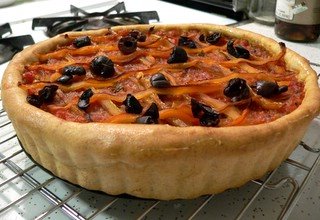
Once again, Deborah Madison saved the day when the CSA assortment of vegetables came in yesterday! The share this week was lettuce, fennel, (lemon) basil, eggplant, a yellow bell pepper, and roma tomatoes. With the help of a friend who came over to help eat the haul, I made use of all but the lettuce and eggplant, supplementing with a few other vegetables, in a fantastic (and rather photogenic) tomato and red pepper tart. It's an interesting dish, halfway a tomato pie, halfway a vegan deepdish cheese-less pizza, and exceedingly tasty. I made two small changes to D.M.'s recipe, adding a little whole wheat flour to the crust, and replacing the anise seed with fresh fennel. The resulting recipe was delicious, despite being a bit complicated and a bit lengthy. The tomatoes were ripe and flavorful, the peppers roasted up perfectly, the fennel and saffron added a bit of complexity, while the olives added a bit of bite. The crust was a simple single-rise yeast dough with some olive oil for flavor, and it managed to be light and crispy. A great find.

Labels:

Tuesday, September 05, 2006

spicy foods: good for diabetics, don't cause heartburn

Some good news on two fronts for fans of spicy foods!

First, as I saw in Science News (subscription only), researchers in Australia found that regularly eating chile peppers as part of meals significantly reduces the amount of insulin produced as a response to eating. (summary) In people with diabetes and pre-diabetic conditions, the pancreas tries to compensate for insulin resistance, an inability of cells to use the sugar in the blood, by increasing insulin production. Eventually the pancreas can't keep up, blood sugar starts fluctuating, and diabetes results. The authors of the study suggest that eating chiles regularly may, by the action of chile-related chemicals in the bloodstream, increase the ease with which insulin can enter cells and trigger metabolism of sugar, thus reducing insulin resistance. This study is part of a series of recent studies that have tended to show that eating chiles increases the metabolism of food, reducing obsesity, and it makes a novel contribution by showing that regular consumption is more helpful than just single spicy meals.

Of course, spicy meals are no good if they give you heartburn or other problems. The researchers in the insulin study report than their previously bland-food-eating participants stopped having noting GI symptoms after just a week of regular spicy meals. This is corroborated by a meta-analysis reported in the New York Times recently, a Stanford study showing that "cutting caffeine, citrus fruits and spicy foods did not eliminate heartburn symptoms." Alcohol and tobacco seem to be causes of heartburn, not chiles.

Refreshing news for those of us who like a little burn with our food...

Labels:

Sunday, August 13, 2006

New Mexican enchiladas

OK, I'm back from the trip and from some fairly stressful grant-writing at work... hopefully I'll be writing here a bit more again...

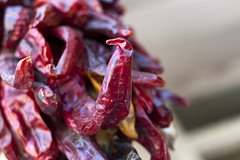
In my parents' home state of New Mexico, enchiladas are unique in a couple of ways. Instead of being a tortilla rolled around a filling and covered with sauce and cheese, the tortillas are flat, with the filling in between. The most traditional New Mexican enchiladas are layers of tortillas and cheese, with red chile sauce (made mostly from dried red New Mexican chiles, the mild but flavorful chiles you see in ristras), and with a fried egg on top. (This reminds me a little of the Korean dish bibimbap for some reason!) I wish I knew the origin of these somewhat unusual variations, but Google was, for a change, no help at all.

I have two interesting variations on the basic recipe (whose main appeal is that it can be scaled up, either by making a casserole, or by, well, just cooking it on a really huge griddle). One is my re-creation of a recipe I had at the Double Eagle restaurant in Old Mesilla, NW. It's a vegetarian enchilada, made with three layers of fillings, one black beans, one corn and tomato, and one garlic, squash, and lime. Of course it uses the traditional red chile sauce and has some cheese and a fried egg on top. Here's the recipe...

The other variation is one I created for a Mexican-themed dinner with my cooking club. I adapted bits of several other recipes to make appetizer-sized enchiladas with wild mushrooms, a green tomatillo-based sauce, a red chile sauce, and fried quail eggs for the top. Despite my using the wrong type of Mexican cheese and not making enough green sauce, they were very good (and pleasantly photogenic!). Along with the photo, here's that recipe...

Labels:

Friday, July 21, 2006

New York City water and bagels

There was recent news that there's been too much clay in NYC water, and the city might have to, for the first time, build a filtration plant to filter out impurities in the water we get from upstate reservoirs. Today, the Times had an article on reaction from bakers:

The wrong water can ruin things, he said. “You can’t use well water to make bagels,” he said. “You could, but they won’t come out right. What, exactly is in that water, I don’t know. I’m not a chemist, I’m just a bagel maker. All I can tell is the water in New York has always been good for bagels, Italian bread, pastries.”

Noel Labat-Comess, the president of Tom Cat Bakery, a wholesale operation in Long Island City, Queens, called the issue of filtration and taste a “nonworry.”

“Water used for bread that’s within a normal range has little or no effect on it,” he said. “It’s only when it gets to the extremes, when it gets extremely mineraly, that it can be a problem. I’ve never run into anyone in my years of baking anywhere that had a problem with their bread that was caused by the water.”

The article says that most of the people they interviewed didn't think water quality mattered much for most cooking, but they did definitely suggest using purified water for making coffee. I suspect Italian ices would also be badly affected by dirty water... I, for one, have a water filter in my fridge for some reason, but I always just use tap water, for cooking and for drinking.

Labels: ,

Sunday, July 16, 2006

popcorn fish

This isn't about tiny little deep fried fish as found at Red Lobster. Thankfully.

For some reason I got it into my head that popcorn would make an interesting ingredient, not just a tasty snack. It might have been the two large bags of gourmet popcorn sitting in my cabinets. In any case, I did some Googling for recipes with popcorn as an ingredient. There aren't very many, and in fact the only recipe I found was one found here, for a popcorn-breaded fried fish fillet.

It's a trivially easy recipe. Pop some popcorn (I like to use my wok for this, as the results are good and it helps to season the wok!). Throw a cup of the popped corn in the food processor until it's pretty fine. Dip fillets of fish in a mixture of egg and milk (I used soy), then coat with the ground popcorn. Add some salt and pepper, and saute on medium-high heat in butter and oil. The recipe calls for catfish; I used tilapia, but suspect the catfish would have been better.
I also slightly undercooked the fish, despite the recipe being trivially easy.... This said, the thinner parts of the fillet were excellent. The popcorn adds a light crunch and corn flavor without the heaviness of a cornmeal breading. The color effects of the white popped corn and the (since I used purple popcorn) dark corn skin were also interesting.
I also made some good steamed/sauteed beets and beet greens, thanks to the CSA and Deborah Madison. And the leftover popcorn, seasoned with seasoned salt, was pretty tasty too...

Labels:

Thursday, July 13, 2006

158-degree eggs for lunch

Over the last several months I've seen several articles talking about "65 degree eggs" (that's Celsius). One of Hervé This's contributions to modern cooking is his rigorous study of how to boil eggs without overcooking them. There are a couple of standard rules of thumb for hard-boiled eggs, like boil them for 10 minutes, or put them in boiling water, turn of the heat, and letting them sit for 13 minutes. However, as This has meticulously documented, either of these techniques tends to overcook the eggs, giving rubbery whites and dry or even greenish yolks. The reason why is quite scientific, and has to do with the temperatures at which various proteins in the eggs coagulate. Discover magazine gives this summary:
Ovotransferrin, the first of the egg-white proteins to uncoil, begins to set at around 61 degrees Celsius, or 142°F. Ovalbumin, the most abundant egg-white protein, coagulates at 184°F. Yolk proteins generally fall in between, with most starting to solidify when they approach 158°F. Thus, cooking an egg at 158°F or so should achieve both a firmed-up yolk and still-tender whites, since at that low temperature only some of the egg-white proteins will have coagulated.

Now, the way This cooks his eggs is with a shockingly expensive digitally controlled oven set to precise temperatures. Yeah, he bakes his eggs, which takes, like, an hour or so. When fellow tech-chef Wylie Dufresne made his appearance on Iron Chef America, he did some sous vide cooking in a convection water bath, also a shockingly expensive piece of gadgetry.

I had an egg I wanted to try this with the other day, an egg I wanted to serve with some CSA lettuce and some basil parmesan dressing. I don't got the time or the money to do it as precisely as the pros, but I do have a digital instant-read thermometer and a little saucepan, and that was enough to get me a budget 65-degree egg.

I boiled a pan of water, then turned off the heat and let the water cool to about 175 degrees. I then dropped in the room-temperature egg (crack! should carefully lowered it in! drat!), covered the pan, and watched the time and temperature. The couple of times the temperature went below about 160 degrees, I turned the heat on to low and let the water get back up to 170 or so. After about 20 minutes of this, I removed the egg, rinsed it in cold water for a few minutes, then removed the shell.

The results were quite intruiging. The yolks were a little like a soft-boiled egg, soft and smooth, with none of the dry graininess of a hard-boiled egg, but definitely set and not runny at all. The whites were unbelievably soft as well. The whole experience of these eggs was remarkable, much better than I had anticipated.

Next time I do this, I'll do a couple things different. First, I won't crack the egg when I drop it in the pot. As you can see from the photo, the egg didn't really hold together that well, and that was a big reason why not. Second, I'll use an egg slicer to cut the egg. A wire instead of a knife will hopefully allow the egg to remain in slices instead of just getting squished. And third, I'll try to get some really fresh pastured eggs from the greenmarket, so see if the reported advantages of those eggs makes the results even that much better.

I'm pretty sure the temperature of the water and the time worked well, though. Room temperature egg, 20 minutes, 160-175 degree water. When mixed with lettuce, and topped with olive oil, white wine vinegar, minced basil, grated parmesan, salt and pepper, it made quite a tasty lunch.

Labels: ,

Lavender: Yep, It's Girly

A couple of weeks ago, the CSA gave us fresh lavender. If I may make use of gender stereotypes for a moment, all of the women in the CSA squealed and said, "yay, lavender, I'll dry it and put in my clothes drawers to make everything smell nice!", while all of the men kinda squinted and said, "uh, can you eat it?" Actually, that's not stereotyping, that's exactly what happened.

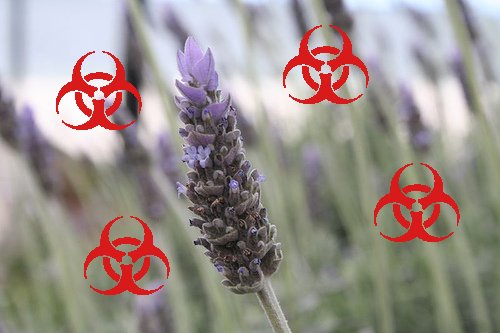
I, of course, decided to cook with it, and found this recipe for lavender hazelnut bread, and made it that weekend. It was OK. The lavender scent was fairly mild, and the base bread was merely fair. It did make for a pretty good picture, though:


I took the rest of the rosemary, dried it upside down in a paper bag, and put the dried rosemary in a jar to use, somehow, at some undetermined point in the future... Time passed...

And then, last week, I got an issue of Science News that filled me with horror, and not just any horror, but emasculated horror!


The article (subscription required) starts as follows:
Two ingredients common in many hair- and skin-care products have been linked to abnormal development of breasts in boys. Lavender oil and tea tree oil contain compounds that act like female sex hormones and interfere with male hormones, researchers have determined.
That's right, a major component of lavender acts like estrogen, and when boys used shampoo or other products containing lavender oil, they grew breasts. When they stopped using the products, the breasts went away in a few months. It probably works on pre-pubescent girls, too, in the sense that if you give them hair or skin products with lavender, they may start developing early.

Spread the word...!

(Original lavender image from Ziggiu)

Labels: ,